The AIT Magazine (AIT | AIT-Dialog – Architecture | Interior | Design) published an article from Els de Vos (Doctor of the University of Antwerp) about the Spider Model Research, the project of ECIA within BCSP project (research and networking project with the collaboration of the University of Antwerp).
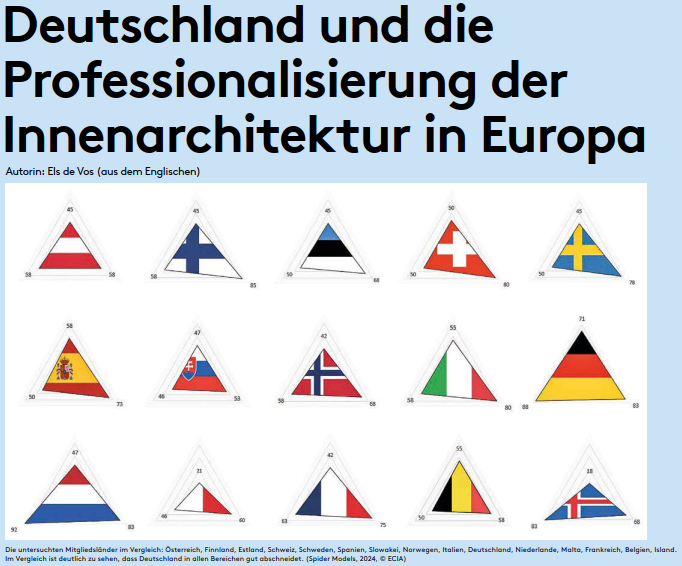
"Germany and the Professionalization of Interior Architecture in Europe
In the following guest article, we explore the profession of interior architects in a European comparison. The insightful article shows that Germany performs very well across all the examined dimensions (legislation, education, as well as professional practice). We should remind ourselves of this more often.
Yours, Carsten Wiewiorra - President bdia”
Thanks in advance to Carsten Wiewiorra for these words, and especially to Els de Vos for this magnificent article and the work carried out on this project. Collecting data to be able to obtain a good overall view of the profession in the different countries of the EU / Europe has been truly meaningful for all of us, to better understand what the reality of our profession is like.
Summary of the article about ECIA Study on the "Spider Model"
In 2017, the European Council of Interior Architects (ECIA) asked its member countries to analyze the professionalization of interior architecture across six aspects: legal regulation, title protection, building permit authorization, liability protection, standardization by national organizations, and education. These were visualized in the "Spider Model."
In 2023, a revised study included all ECIA member countries, condensing the original six axes into three. This study shows the diversity in the profession's development, with varied educational paths, legal regulations, and title protections across Europe.
Key Findings:
· Terminology: The term "interior architecture" is commonly used in Europe, though local variations exist, such as "interieurarchitectuur" in Belgium or "Innenarchitektur" in Germany. This diversity in terminology reflects the different professional hierarchies across countries, from decorators to architects.
· Legal Protection: Only a few countries, like Germany and the Netherlands, legally protect the profession’s title, ensuring that only qualified professionals can use it. Other countries, such as Spain and the UK, have more complex systems, with certain titles being protected but others not.
· Educational Institutions: There is no uniform educational structure across Europe. Some countries offer specialized programs, while others have varied institutions, ranging from universities of applied sciences to fine arts academies. A common structure is a 3-year Bachelor's followed by a 2-year Master's.
· Doctoral Studies: Doctoral programs in interior architecture are rare in Europe. Countries like Belgium and Austria offer such programs, but they are not widespread. Germany, however, has structured programs, and doctoral qualifications are crucial for professorships.
· Regulation: The profession’s legal framework varies, with some countries having strict regulations (Germany) and others offering more freedom (Scandinavia, Belgium). Title protection can promote recognition but does not always lead to easier professionalization.
In conclusion, the study reveals the complexity and variation in the professionalization of interior architecture in Europe, with Germany standing out for its well-regulated system. However, there is a need for more doctoral programs and a careful balance between regulation and flexibility in the profession.
If you want to know more about the Spider Model Research of ECIA, remember that you can read about it at the following link: Spider Models Research | ECIA
We are currently starting to work on this topic for the remaining countries and to share the article again.